
Rift Commanders
Rules of play
Everything you need for your first game, cards in hand. Fifteen minutes of reading, plus the A to Z reference for the tricky questions.
- 2 players
- 30 minutes
- 40 health
- 5 cards in hand
Two documents. This booklet teaches you how to play: it only contains the general rules. During a game, for a question about a card or a keyword, open the Reference: keywords and cards are listed from A to Z, with every clarification.

Introduction
Rift Commanders is a deckbuilding game for 2 players, ages 12 and up, with games lasting about 30 minutes. Each player is a commander leading a faction. Over the course of the game, they buy creatures, spells and traps from a shared recruitment zone.
Goal: reduce your opponent's health to 0. Each commander starts with 40 health. The first commander at 0 loses the game.
Four factions clash:
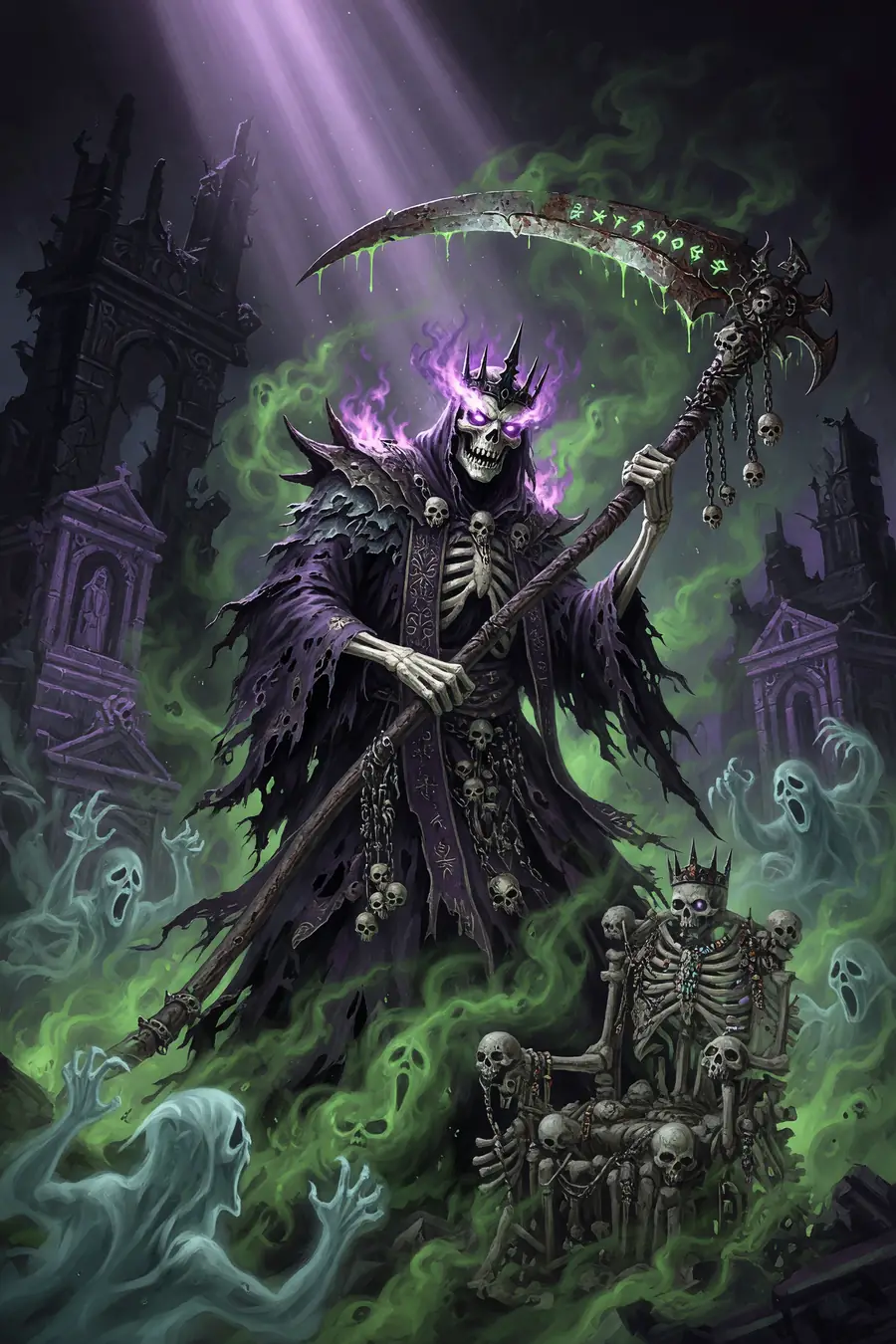
 Brutal DeathHosuld, Wraith of DreadPoison, sacrifices, discard. It wins slowly, then all at once.

 Sacred SentinelsLoth, Supreme InquisitorHealing, defense, Cure. It holds the line while the others wear out.

 Servi ScientiaDr. ZetètikósExile, Rift, card search. It builds the deck it wants.
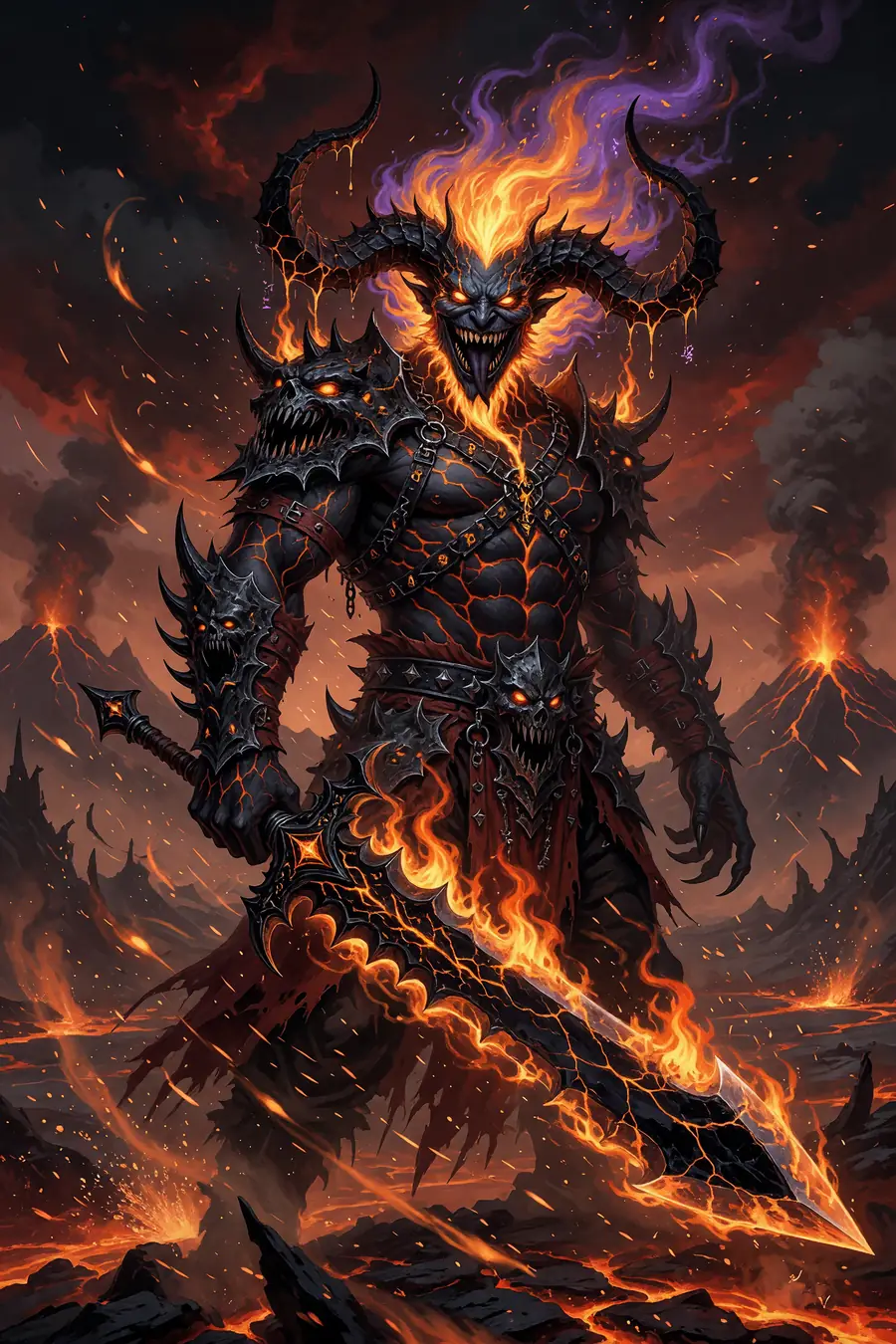
 Heart of the AbyssNarr’manox, the Mad LordMassive Wound and Rush. It strikes before you finish your sentence.
Your starting faction is not a prison. Allegiance lets you recruit from the other factions, and the best cards often require two allegiances or more.

Components
| Item | Quantity | Use |
|---|---|---|
| Lost Soul | 20 | 5 per starter deck |
| Essence Collector | 4 | 1 per starter deck |
| Volatile Essence | 8 | 2 per starter deck |
| Starter creatures | 8 | 2 per faction: Plaguebearer (Black), Blessed Guardian (White), Disruption Drone (Blue), Biting Skull (Red) |
| Recruitment cards | 80 | 20 per faction: 10 creatures, 8 spells, 2 traps |
| Rites | 4 | One per faction; only one per player during the game |
| Counters | per player | Health, allegiance in each faction, poison |
The box contains the 4 starter decks, one per faction, so that everyone can play the faction of their choice. A duel uses 2 of them. Unused starter cards stay in the box for the whole game. Use tokens to track your soul essence during the turn.
Exile pile: a shared face-up pile where every exiled card goes. Keep room for it next to the recruitment zone.

Setup
- Pick a commander. Each player picks a different faction.
- Build your starter deck (10 cards): 5 Lost Souls, 1 Essence Collector, 2 Volatile Essences and the 2 starter creatures of your faction. All starter decks are identical except for these 2 creatures. Shuffle it face down: this is your deck.
- Set your counters: 40 health, 1 allegiance in your faction, 0 in the other three, 0 poison.
- Prepare the recruitment zone: shuffle the 80 recruitment cards, place them face down (the recruit deck) and reveal 8 of them face up in the middle of the table.
- Place the 4 Rites face up next to the recruitment zone.
- Pick the first player at random or, for a rematch, the loser of the previous game.
- Draw: 3 cards for the first player, 5 for the second. There is no mulligan. The first player refills their hand to 5 cards at the end of their first turn, as usual. The second player also gains 2 extra soul essence at the start of their first strategy phase; it is lost at the end of the turn like any other essence.

Anatomy of a card
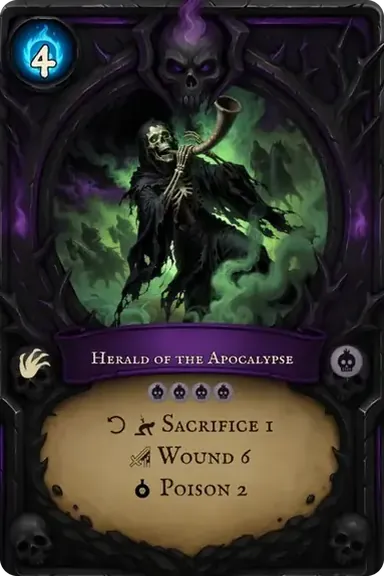
- Cost
- The essence price to buy it from the recruitment zone. Playing it afterwards is free.
- Type
- A claw for a creature, a spiral for a spell, a wolf for a trap.
- Allegiance
- Each icon requires one allegiance point in that faction to play the card.
- Effects
- ⟳ marks an ability you activate by exhausting the creature. The tombstone marks Demise.
Reading the text box:
- ⟳: what follows is an activated ability. You use it by exhausting the creature. Every following line, conditional lines included, is part of the same activation, up to a Demise line. Only exception: ⟳ Guard, which is used during the opponent's turn and is not an activation.
- Demise (tombstone): the effect triggers when the creature is destroyed.
- Conditional line: a line that starts with a number followed by a colon (for example "3 Black: Poison 2", written with the Black icon) only applies if your allegiance in that faction reaches that number when the line resolves. Otherwise, skip it.
- Soul icon (blue dot): each dot gives you 1 soul essence.
- "You may", "up to X": the effect is optional. Every other effect is mandatory.
Example: a card that requires 2 Red icons and 1 White icon can only be played if you have at least 2 Red allegiance and at least 1 White allegiance.
Resources
 Soul essenceSpend it to buy cards and gain allegiance. Whatever you don’t spend is lost at the end of the turn.
 AllegianceFrom 0 to 6 per faction, and it never goes down. At 6, you take that faction’s Rite if it is still free.
Soul essence
Soul essence is used to buy cards and raise your allegiance. You gain it by playing cards with the Soul icon: Lost Souls, Volatile Essences, Essence Collector and some faction cards. The gain is mandatory. Essence never goes below 0. It stays available until the end of your turn, then it is lost.
Playing a card costs nothing. A card's soul cost is its purchase price. Once in your hand, a creature is summoned and a spell or trap is played for free, as long as you have the required allegiance.
Buying: pay the soul cost of a card in the recruitment zone and put it in your discard pile. Replace it immediately with the top card of the recruit deck, before any reaction. You can buy as many cards as your essence allows, one at a time. If the recruit deck is empty, emptied slots stay empty and the other cards don't move. Buying is optional. You can buy a card without the required allegiance: allegiance is only needed to play it.
Allegiance
Allegiance measures your bond with each faction, from 0 to 6. It never decreases.
- Once per turn, during the strategy phase, you may pay 1 essence to gain 1 allegiance in the faction of your choice.
- Allegiance X effects on cards are added on top of this action and don't count toward the once per turn limit.
- Any point beyond 6 in a faction is lost.
- Allegiance is checked once when you play a card, then again when each conditional line resolves.
- Threshold: on cards, "3 Blue: effect" reads "if you have at least 3 Blue allegiance, resolve the effect". Otherwise, the line is skipped.

Turn sequence
- 1
 InitiationPoison strikes, then one counter fades.
- 2Strategy phaseSouls, purchases, summons, activations, spells. In any order you like.
- 3
 CleanupReady, keep 0 to 2 cards, draw up to 5.
Each turn has three phases, always in this order: initiation, strategy phase, cleanup.
1. Initiation phase
- Poison: if you have at least one poison counter, take as much damage as you have counters, then remove 1. There is no limit to the number of counters. This damage is not Wound: nothing can cancel or reduce it.
- If your health drops to 0, you are eliminated immediately and the game ends.
2. Strategy phase
You take the following actions as many times as you want, in any order, unless stated otherwise:
- Play a Soul card: gain the essence shown.
- Raise your allegiance: 1 essence for +1 in a faction, once per turn.
- Cast a spell: resolve its effects, then put it in your discard pile.
- Summon a creature: put it on your battlefield, exhausted.
- Activate a creature: exhaust a ready creature and resolve its ⟳ ability.
- Buy cards from the recruitment zone.
An action only starts once the previous one is over, waiting effects included. Wound is dealt as soon as the effect that produces it resolves. There is no separate attack phase.
3. Cleanup phase
No cards are played during this phase.
- Ready all your creatures.
- Resolve "end of your turn" effects. They are waiting effects of the active player: you choose their order.
- Unspent soul essence is lost.
- Keep 0, 1 or 2 cards from your hand, your choice. Discard the others, along with the Soul cards played this turn. Spells and traps are already discarded after they resolve; creatures stay on the battlefield.
- Draw until you have 5 cards in hand. If your deck is empty, shuffle your discard pile to form a new deck. Do it as soon as you have to draw, even in the middle of an effect, as many times as needed. If both are empty, draw what you can.
So during the opponent's turn, you hold the 5 cards of your next turn. You play your traps from this hand, and an opposing Discard effect targets it. Cards you receive during the opponent's turn are added to it without limit: the 2 kept cards limit only applies at step 4 of your cleanup.
Playing a card or activating a creature
Every card played and every ability activated follows the same steps. Splitting them this way tells you exactly when each trap and each effect happens.
- Announce. Show the card or point at the creature. Check that the action is allowed: required allegiance, a free battlefield slot for a creature, a ready creature not yet activated this turn for an activation, a Sacrifice cost that can be paid in full. If a condition is missing, the action doesn't happen: take the card back, with no consequence.
- The card is played. It leaves your hand and stays in front of you while it resolves. A summoned creature enters the battlefield. An activated creature is exhausted. From this moment, the card counts as played, the creature as summoned or the ability as activated. Effects triggered by this event (Rite of the Blaze) wait.
- Opponent's window. Before anything resolves, the opponent may play traps without a trigger or "each time" traps. Anointing of Souls played here protects their creatures before the card destroys them. After a summon, this is also the window for Call from the Grave and Burning Hand.
- Pay the cost. Every Sacrifice on the card is paid now, together, even if written further down.
- Resolve. Read the lines from top to bottom. Each line does what it can, then reading continues, even if the previous line did nothing. Nobody acts during resolution, except with a "when" trap.
- Finish. A spell goes to the discard pile, a Soul stays in front of you until cleanup. Then waiting effects resolve, down to the last one.
A summon has nothing to resolve: it goes from steps 1-2-3 to step 6. A trap follows steps 1, 2, 5 and 6: no trap ever responds to a trap.
Creatures, spells and traps
 CreaturesThey stay in play, five at most, and activate once per turn.
 SpellsCast during your turn, resolved top to bottom, then discarded.
 TrapsPlayed during your opponent’s turn. Each one draws you a card.
Creatures
- Summon: a summoned creature enters your battlefield exhausted (turned sideways). You can have at most 5 creatures in play. With 5 creatures, the creature stays in your hand; as soon as a slot frees up, you can summon it. To free a slot yourself, use a Sacrifice effect.
- Activate: a ready (upright) creature can be activated once per turn, during your strategy phase: exhaust it and resolve its ⟳ ability. A creature can't be activated the turn it is summoned, unless it has Rush.
- Rush: a creature with Rush enters ready and can be activated the turn it is summoned.
- Ready: your creatures are readied at the end of your turn. So they are ready during the opponent's turn, which lets Guard protect you from the turn right after the summon.
- Passive abilities (Aegis, Rush): they work while the creature is in play, even exhausted.
- Destroyed: the creature goes straight to its owner's discard pile and loses its abilities. Its Demise waits. It will come back to its deck at the next shuffle.
- A card that changes zones is a new card. A creature returned to hand and summoned again enters exhausted, with no memory of its past.
Spells
A spell is cast during your strategy phase, if you have the required allegiance. Resolve its effects from top to bottom, then put it in your discard pile.
Traps
A trap (wolf icon) is played from your hand during your opponent's turn, if you have the required allegiance. Never during your own turn, cleanup phase included. It resolves, then it is discarded, even if it had no effect. When you play a trap, draw a card: a trap doesn't cost you a card from your next hand. Its effect no longer depends on the card: if it lasts until the end of the turn, it keeps working after being discarded.
There are three kinds of traps:
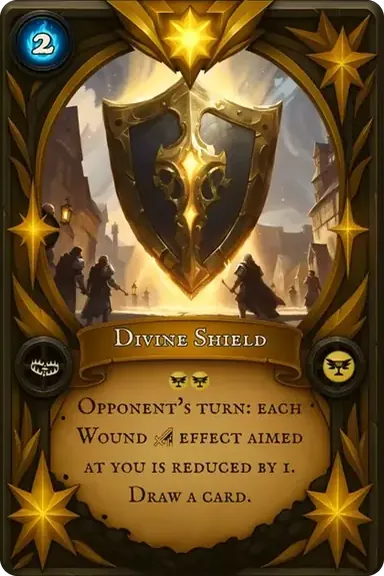
- No trigger (Divine Shield, Anointing of Souls): play it when nothing is resolving, especially in the step 3 window, right after a card is played or an ability is activated. Never between two lines of a card. It works until the end of the turn, but not on an effect that has already resolved.
- "Opponent's turn: each time…": same timing. Then, until the end of the turn, it reacts to each matching event, whatever its cause. No retroactive effect. Its effect is a triggered effect: it waits.
- "Opponent's turn: when…": play it right after the described event, even in the middle of an opponent's card. It only reacts to an event caused by your opponent. The trap resolves fully, then the effects it triggered resolve following the usual priority, then the opponent's card resumes where it was. This is the only exception to the rule "a card resolves fully". The window closes as soon as reading resumes.
You can play several traps during the same opponent's turn, including several "when" traps on the same event, one after the other. A trap never responds to another trap, nor to what a trap causes. A card that reached your hand during the opponent's turn can be played as a trap as soon as nothing is resolving, but not against an event that already happened.
Keeping cards in hand at the end of your turn (up to 2) lets you hold a trap for the opponent's turn, or make them believe you have one.
The 8 traps of the game:
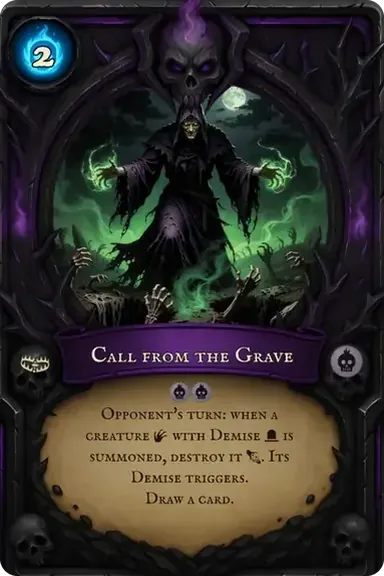
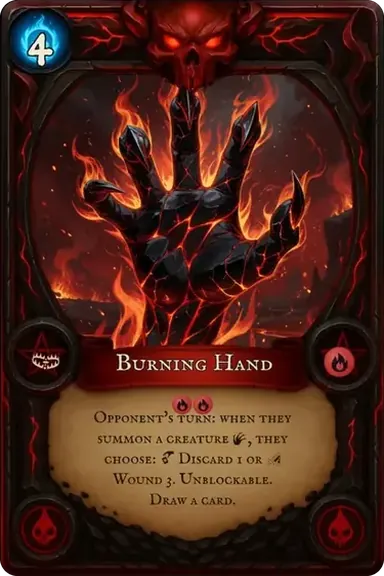
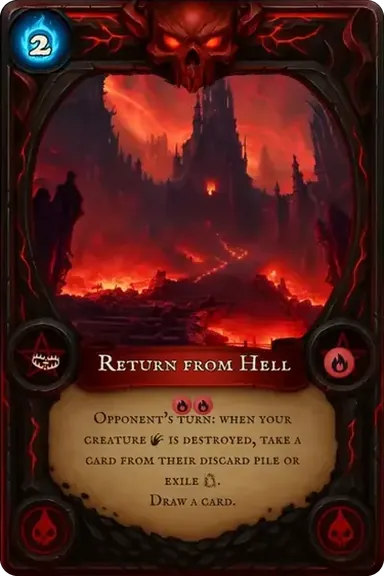
The clarifications for each trap are in the Reference.

Effects and keywords
Only commanders have health. Creatures don't: they never take damage, they are only destroyed. Vocabulary: Wound is the keyword, damage means the health lost. You buy a card from the recruitment zone, you play a spell, a trap or a Soul, and you summon a creature. A keyword written with a capital letter (Destroy, Sacrifice, Wound…) always means the keyword itself: "Destroy" on a card refers to the Destroy X effect, not to every way of destroying a creature.
Keywords at a glance
- SoulGain 1 soul essence per icon.
 Wound XDeal X damage to the opposing commander. Each occurrence is a separate effect.
- UnblockableThis Wound can't be reduced or cancelled.
- Poison XAdd X poison counters to your opponent.
 Heal XRegain X health, up to 40.
 CureRemove all your poison counters.
 Sacrifice XCost. Destroy X of your other creatures. If you can't pay in full, you can't play the card or activate the ability.
 Destroy XDestroy X opposing creatures of your choice.
 Discard XYour opponent discards X cards from their hand, of their own choice.
 Exile XExile X face-up cards from the recruitment zone, one at a time. Each is replaced at once.
 Rift XSwap up to X cards from your hand with as many cards from the exile pile.
 Research XSearch your deck for up to X cards of your choice, add them to your hand, then shuffle. Empty deck: nothing.
- Allegiance XSplit X allegiance points among the factions of your choice.
 RushThe creature enters ready and can be activated the turn it is summoned.
 DemiseEffect that triggers when this creature is destroyed. Not when it is exiled.
 GuardDuring the opponent's turn, cancels a Wound effect; the creature is destroyed.
 Aegis XEach Wound effect aimed at you is reduced by X.
Destroying and exiling: a destroyed creature goes to its owner's discard pile and triggers its Demise. An exiled card goes to the shared exile pile and triggers nothing. Only a Rift effect can take it back.
Each keyword has its full entry in the Reference.

Order of resolution
General principles
- The card text takes precedence over the rulebook.
- One duel, two players. "The opponent" is always the other player. A card belongs to its owner and never goes to the opponent; an exiled card belongs to nobody, and a card taken back from the exile pile with Rift belongs to the player who takes it. Each card has a single type: Soul, Creature, Spell, Trap or Rite. Allegiance never decreases.
- Every effect is mandatory, unless it says "you may" or "up to X": in that case, you choose a number between 0 and X.
- As much as possible. An effect without enough targets does what it can, then reading continues. An effect with no target does nothing. A card can be played even if its effects have no consequence, as long as its cost is paid.
- No action during a resolution. You can't buy, play a card or spend essence between two lines of a card, nor while effects are waiting. Only exceptions: the opponent's window, right after a card is played or an ability is activated (even if effects are already waiting), and "Opponent's turn: when…" traps.
- Who chooses. The player resolving the effect chooses its targets: destroyed creatures, exiled cards, allegiance split. Exception: for Discard, the victim chooses.
- Public information. Played cards, the battlefield, the discard pile, the exile pile, the counters and the number of cards in each deck and each hand are visible to everyone. The contents of hands and decks are secret.
- Immediate end. As soon as a commander drops to 0, the game ends, even in the middle of a card. Everything left to resolve is ignored.
Chains
A card always resolves fully before anything else happens. Triggered effects wait their turn.
- A card or activation resolves completely, effect by effect, from top to bottom.
- Triggered effects wait. A Demise, an "each time" effect, a Rite or end of turn effect is put on hold. Waiting effects resolve when the card or activation is over. They never modify a card being resolved.
- The active player goes first. While effects are waiting, the active player resolves one of theirs, of their choice, if they have any; otherwise, the opponent resolves one of theirs. After each resolved effect, start over. A newly triggered effect joins its owner's waiting effects: the active player always has priority, even over effects that appear along the way. An effect belongs to the owner of the card that produces it: the Demise of an opposing creature you destroy is your opponent's effect.
- A waiting effect always resolves, even if its source left play. If it no longer has a target, it does nothing and disappears.
- A card's text can make an exception. "Immediately" acts right away. "After its effects" waits for the end of the activation.
- Conditional lines are checked as they are read. If the allegiance threshold isn't reached at that moment, the line is skipped. Allegiance gained further down the card doesn't count for a line already read, but counts for the following ones.
- Guard, Aegis and Divine Shield are not triggered effects. They modify a Wound effect at the very moment it resolves.

Defense
Three things protect your commander against Wound: Guard, Aegis and the Divine Shield trap. None of them works against poison or against Unblockable Wound. A Wound effect always targets the opposing commander of the player who produces it.
⟳ Guard: during your opponent's turn, when a Wound effect targets you, you may exhaust this ready creature to cancel that effect entirely. The creature is then destroyed, and its Demise triggers. One Guard cancels a single effect. Guarding is not an activation: the creature only needs to be ready.
Aegis X: while this creature is in play, each Wound effect aimed at you is reduced by X. It isn't exhausted and isn't destroyed. Several Aegis don't stack: only the strongest applies.
Facing a Wound effect aimed at you:
- Aegis reduces the damage.
- Divine Shield, if active, reduces the remaining damage by 1 more.
- You decide whether to use a Guard to cancel what remains.
- The remaining damage is dealt. If a commander drops to 0, the game ends.
Damage cancelled or reduced to 0 is not dealt and triggers nothing.

Rites (passive cards)
The first player to reach 6 allegiance in a faction takes that faction's Rite and keeps it in front of them until the end of the game. There is only one copy of each Rite: once taken, it is no longer available. Each player can own only one Rite for the whole game, placed on their Rite slot. If they reach 6 in another faction while already owning one, they take nothing: that Rite remains available to the opponent. A Rite once gained can never be lost.
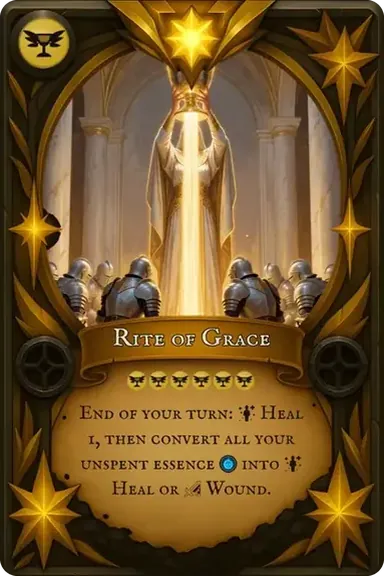
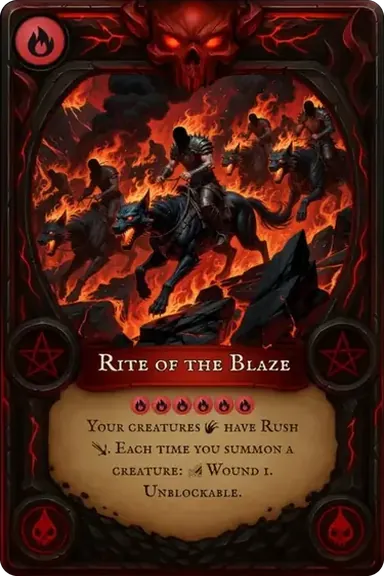
A Rite is taken the moment 6 is reached, even in the middle of a card or during the opponent's turn, and acts from the next event on, never on what happened before. Its effects are triggered effects: they wait and follow the order of resolution. A Rite is neither a creature nor a card in play: no effect can target it. The clarifications for each Rite are in the Reference.
End of the game
- Defeat: a commander whose health drops to 0 loses immediately, at any time during the turn, including during their initiation phase.
- Victory: the commander still alive wins. The game ends at the first commander at 0: everything still waiting or left to read is ignored. No effect wounds both players at once, so there is never a draw.
Examples
Tap an example to open it.
Example 1: Blood Sacrifice
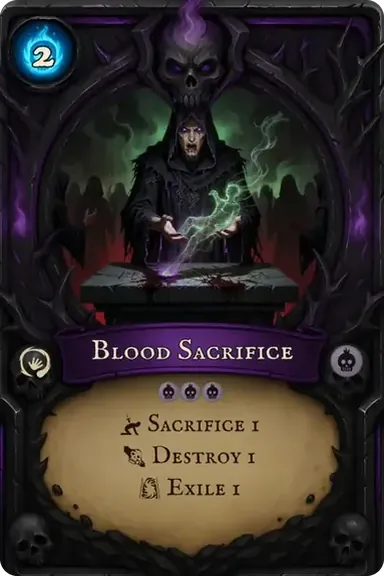
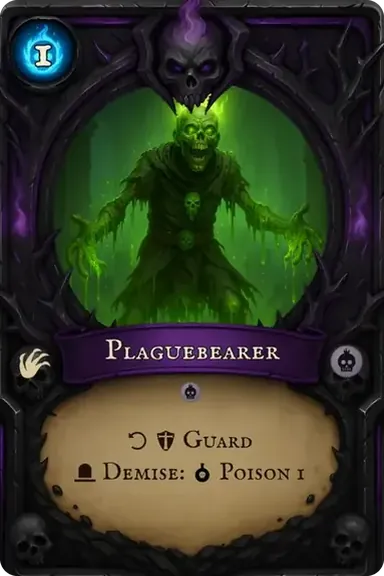
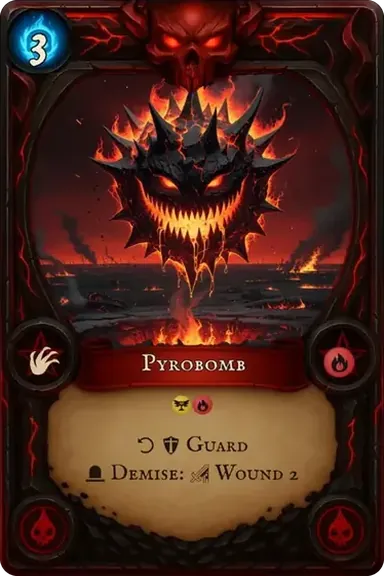
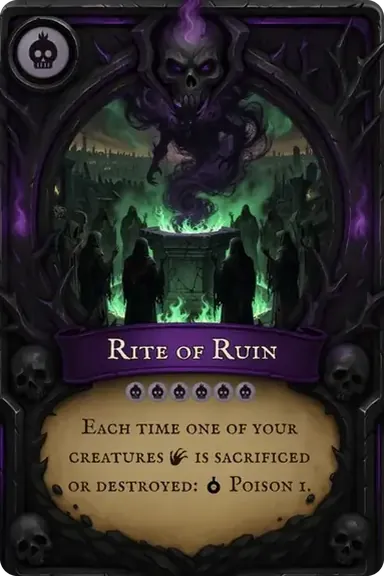
You play Blood Sacrifice (Sacrifice 1, Destroy 1, Exile 1). You have a Plaguebearer in play, and your opponent has a Pyrobomb.
- Cost: you sacrifice your Plaguebearer. Its Demise (Poison 1) waits.
- Destroy 1: you destroy the opposing Pyrobomb. Its Demise (Wound 2) waits.
- Exile 1: you exile a card from the recruitment zone.
- The card has resolved. You are the active player: your Plaguebearer's Demise resolves (your opponent receives 1 poison counter). If you own the Rite of Ruin, its Poison 1 also goes before the Pyrobomb.
- Then the Pyrobomb's Demise: your opponent deals you Wound 2. It's your turn: you can't guard.
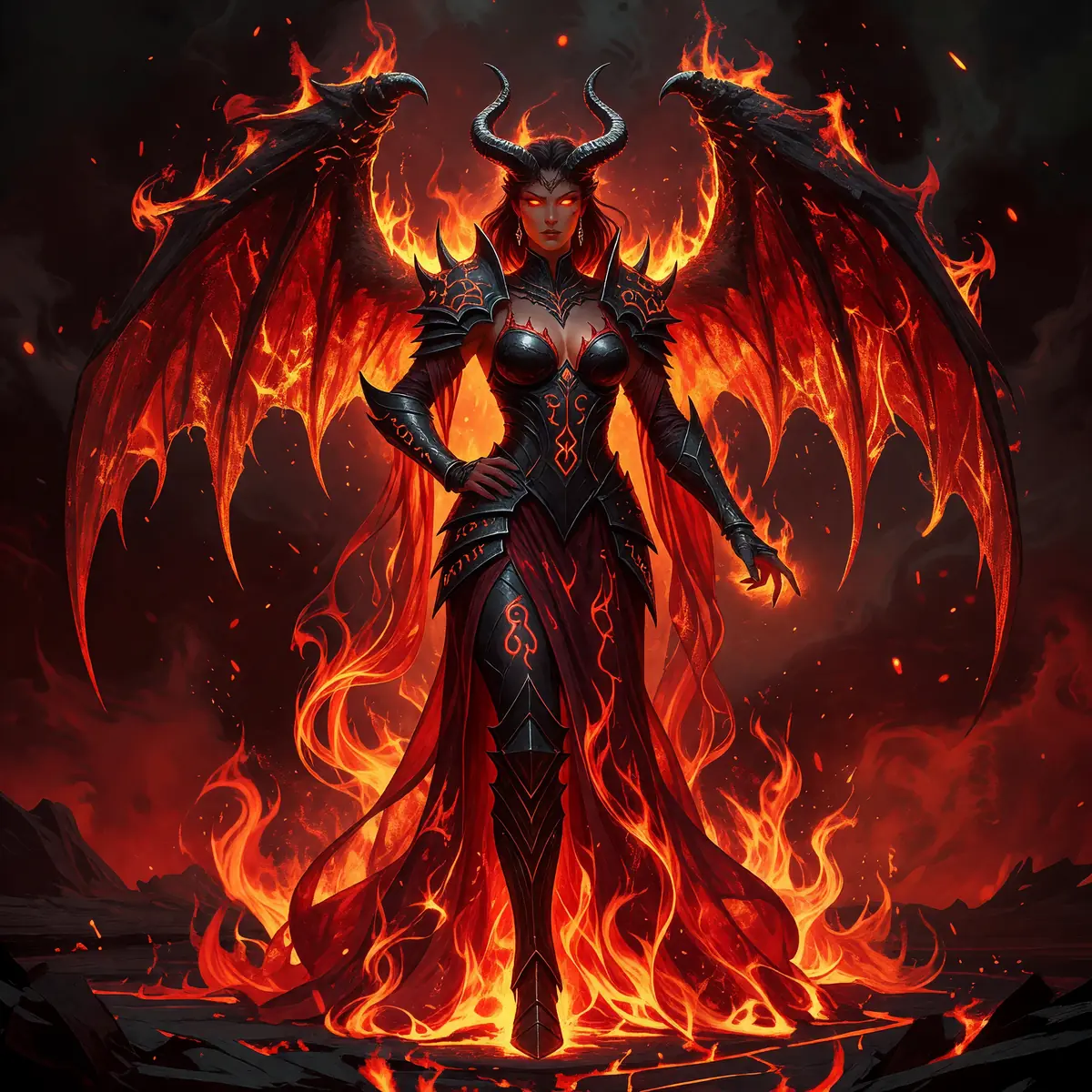
Example 2: Herald of the Apocalypse
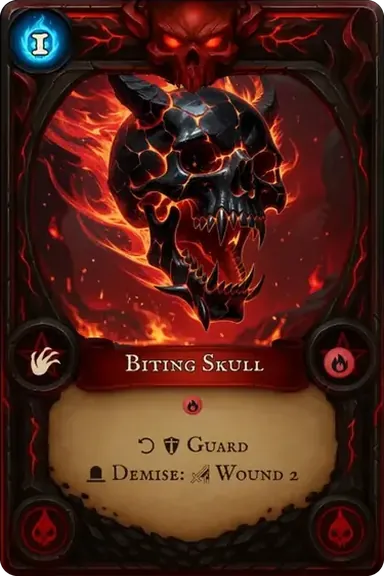
You activate the Herald (Sacrifice 1, Wound 6, Poison 2) and sacrifice a Biting Skull (Demise: Wound 2). The Herald's Wound 6 and Poison 2 resolve first. Only then does the Biting Skull's Demise deal Wound 2. If your only creature is the Herald itself, you can't activate it: it can't sacrifice itself.
Example 3: Destroy against too few creatures
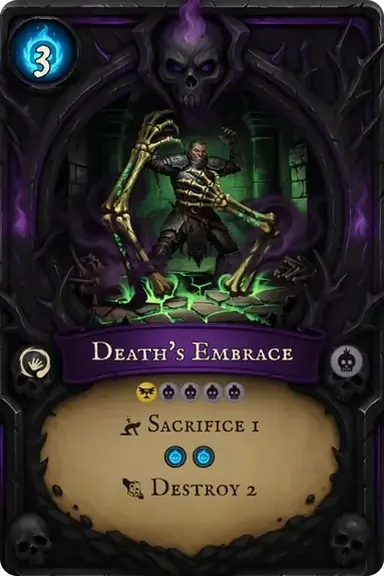
You play Death's Embrace (Sacrifice 1, 2 Souls, Destroy 2) while your opponent has only one creature. You must be able to pay Sacrifice 1. You gain 2 essence, then Destroy 2 destroys the only opposing creature. The second Destroy point is lost.
Example 4: a trap in the middle of an activation
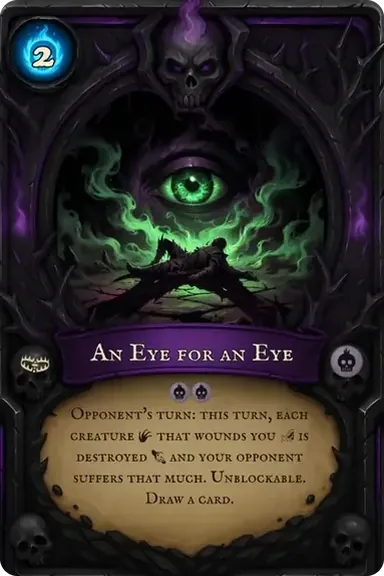
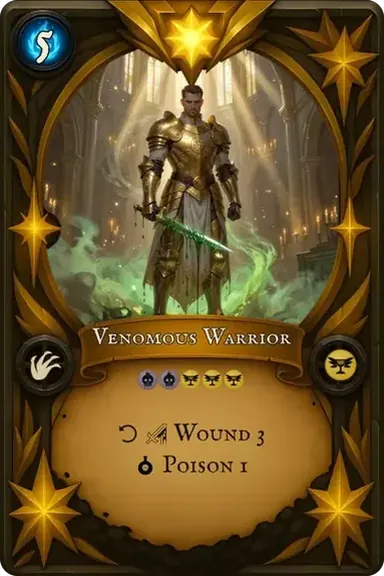
Your opponent casts a spell: Wound 3, then Exile 1. You have An Eye for an Eye in hand, but it only reacts to creatures: you can't play it. Next turn, they activate their Venomous Warrior (Wound 3, then Poison 1). The Wound is dealt: you play An Eye for an Eye right after, and your opponent also suffers Wound 3, Unblockable. The Warrior finishes its activation (Poison 1), then it is destroyed. Until the end of the turn, every other creature that deals you Wound meets the same fate.
Example 5: Guard, Aegis and Divine Shield
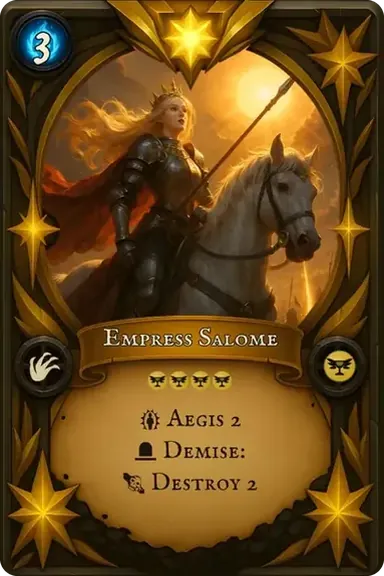

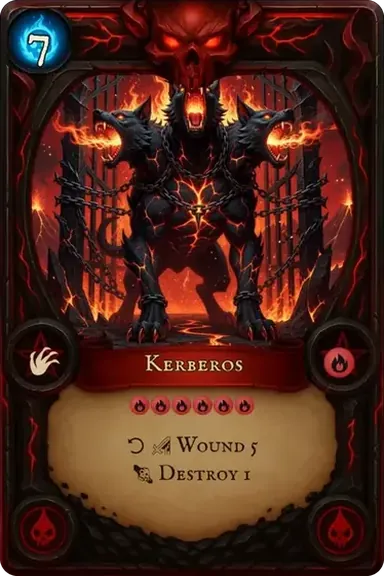
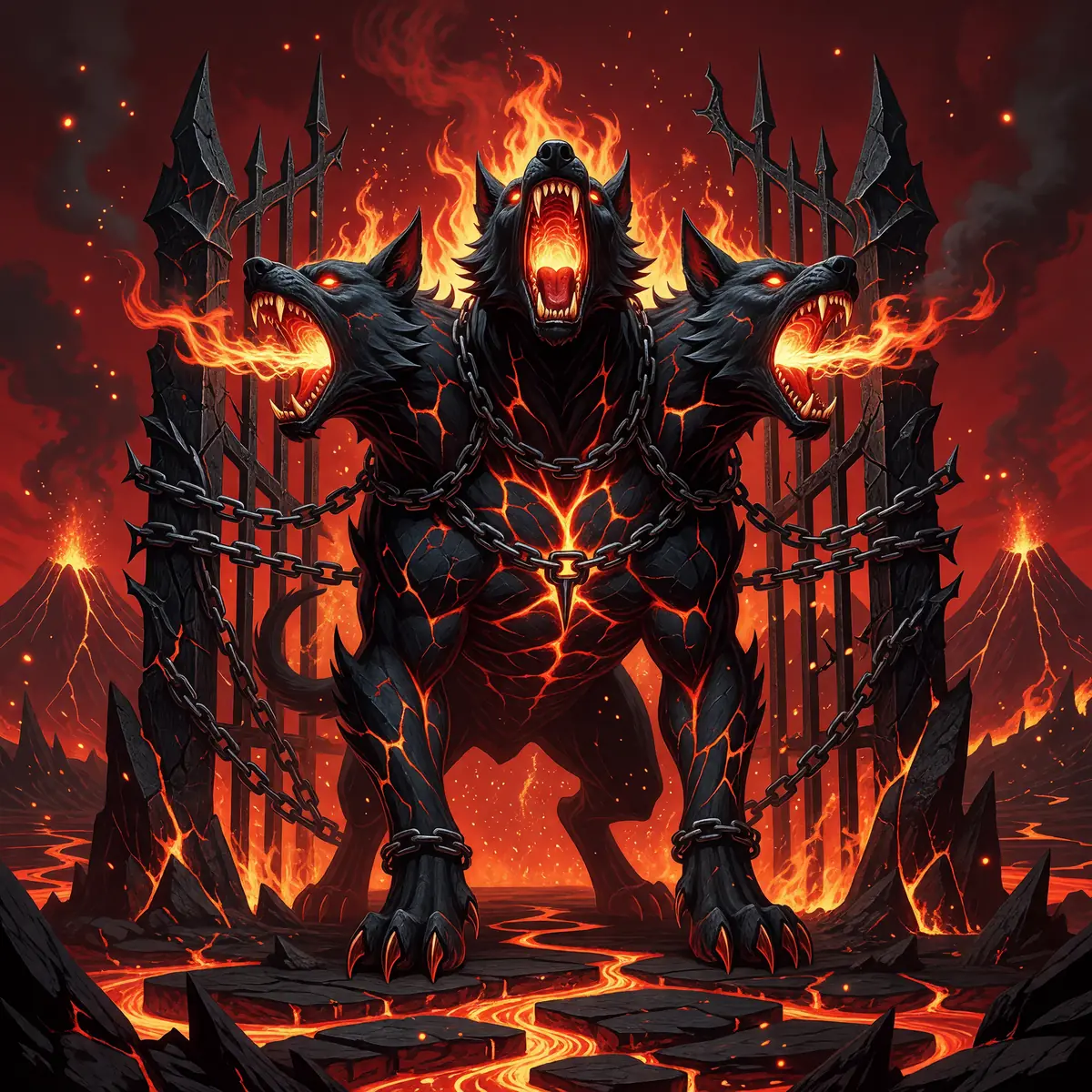
During your opponent's turn, you have Empress Salome (Aegis 2, Demise: Destroy 2) and a ready Blessed Guardian. You play Divine Shield. Your opponent activates Kerberos (Wound 5, then Destroy 1).
- Wound 5: Aegis reduces it to 3, Divine Shield to 2. You guard with the Blessed Guardian: the effect is cancelled, the Guardian is destroyed and its Demise (Heal 3) waits.
- Destroy 1: your opponent destroys the Empress. Her Demise (Destroy 2) waits.
- The activation is over. The active player has no waiting effect: you resolve yours in the order of your choice, Heal 3, then Destroy 2 on two opposing creatures.
Example 6: chained Demise
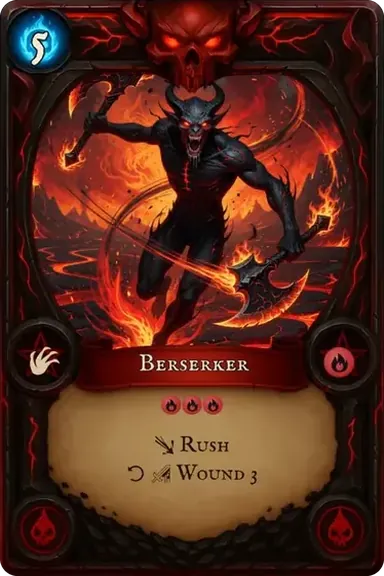
You activate your Berserker (Wound 3). Your opponent guards with their Pyrobomb (Guard, Demise: Wound 2): your Wound is cancelled and the Pyrobomb is destroyed. Its Demise waits and resolves after your activation: it deals you Wound 2. It's your turn, so you can't guard against it.
Example 7: Anointing of Souls
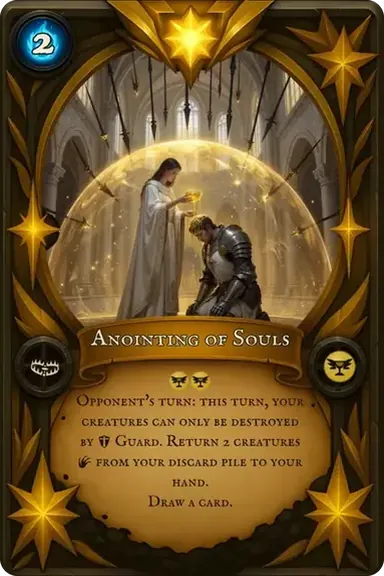
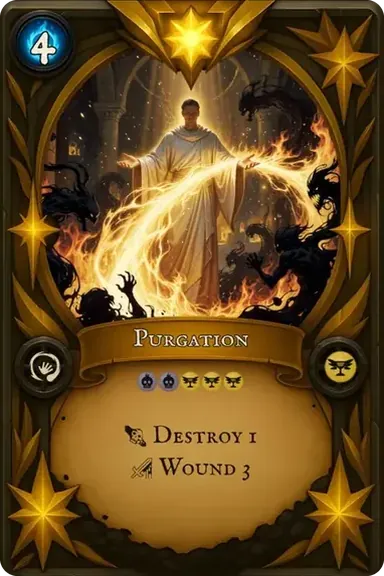
Your opponent activates Kerberos (Wound 5, Destroy 1). In the window, you play Anointing of Souls and draw a card. Wound 5: you guard with your Blessed Guardian. It is destroyed despite Anointing, because Guard is the only exception, and its Demise waits. Destroy 1 destroys nothing: your other creatures are protected until the end of the turn. Later, your opponent casts Purgation (Destroy 1, Wound 3): the Destroy has no effect, the Wound 3 is dealt normally. Anointing only protects your creatures: if your opponent sacrifices theirs to pay a Sacrifice, they are destroyed.
Example 8: a Rite taken too late
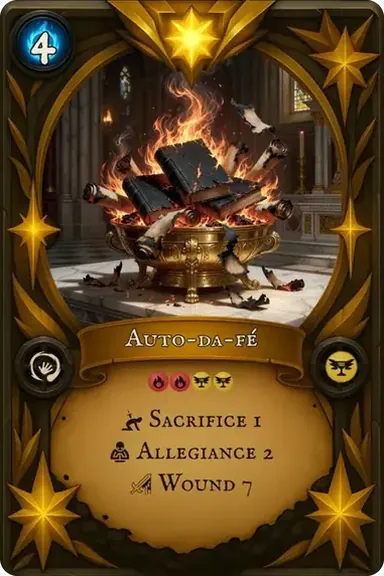
You have 5 in Black and no Rite. You cast Auto-da-fé (Sacrifice 1, Allegiance 2, Wound 7). The cost is paid first: your creature is sacrificed. Then Allegiance 2 brings you to 6 in Black: you take the Rite of Ruin. It doesn't act on the creature already sacrificed. However, if one of your creatures is destroyed later in the turn, it triggers.
Example 9: Rift
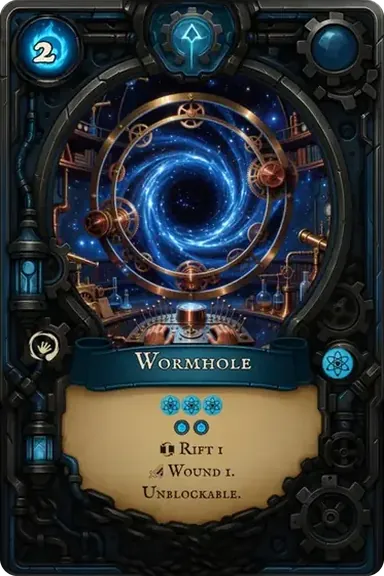
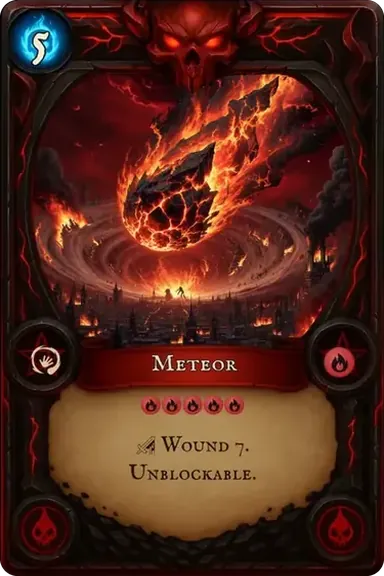
You cast Wormhole (2 Souls, Rift 1, Wound 1 Unblockable). The exile pile contains a Meteor. You swap a Lost Soul from your hand for it: the Lost Soul goes to the exile pile, the Meteor becomes your card. Your deck loses a starter Soul and gains a strong card. If you have 5 in Red, you can cast the Meteor as soon as Wormhole has resolved.
Example 10: a trapped purchase
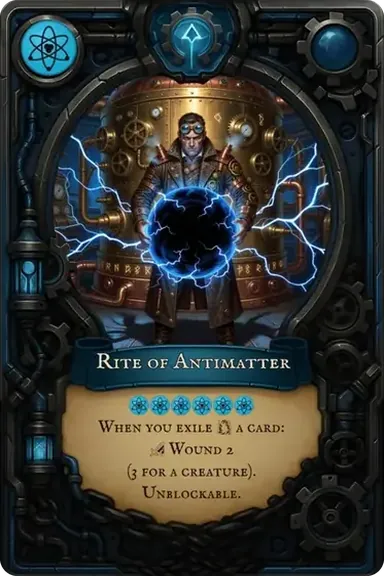
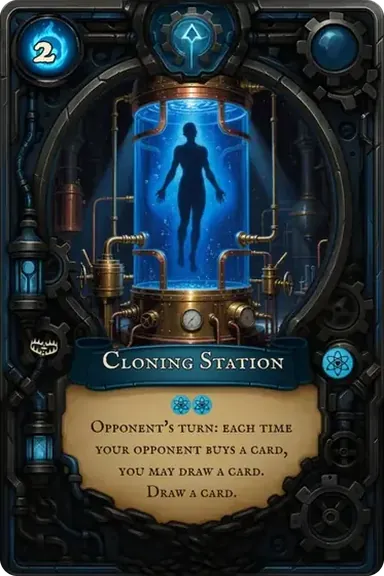
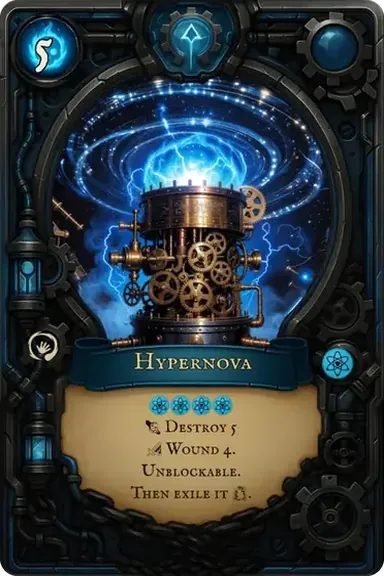
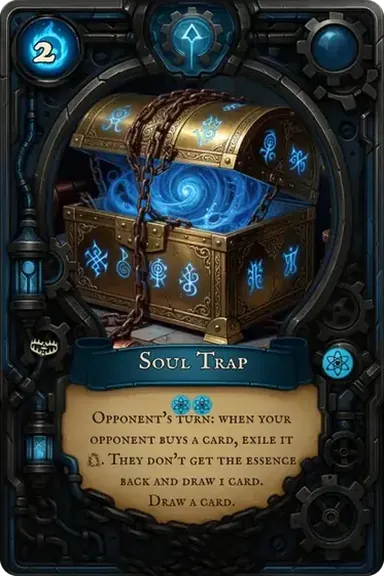
Your opponent owns the Rite of Antimatter and played Cloning Station earlier in your turn. You buy a Hypernova.
- You pay, the Hypernova goes to your discard pile, its slot is refilled. Cloning Station triggers and waits.
- Your opponent plays Soul Trap: the Hypernova is exiled, your essence isn't refunded and you draw 1 card. Their Rite of Antimatter triggers (Wound 2: the Hypernova is a spell) and waits.
- You have no waiting effect: your opponent resolves theirs in the order of their choice, the Cloning Station draw and the Unblockable Wound 2.
Example 11: the game ends
Your opponent has 4 health. You activate the Herald and sacrifice a Biting Skull (Demise: Wound 2). The Wound 6 drops your opponent to 0: you win immediately. The Biting Skull's Demise, still waiting, is ignored.
Example 12: eliminated by poison
You have 3 health and 4 poison counters. In your initiation phase, you take 4 damage: you drop to -1 and lose immediately, before you can play anything.

Variant: recruitment zone mulligan
For experienced players who want to depend less on the starting luck.
- After setup and before the first turn, each player, starting with the first player, may set aside 0 to 2 cards from the recruitment zone, one at a time.
- Each card set aside is replaced immediately by the top card of the recruit deck, before choosing the next one.
- When both players are done, shuffle the cards set aside into the recruit deck.
This variant only affects the recruitment zone. It changes neither your starting hand nor the second player's compensation essence.
Credits
- Design: Benoît Morin.
- Icons: game-icons.net, under the CC BY 3.0 license (authors: Lorc, Delapouite and contributors).
- Fonts: IM FELL English SC (Igino Marini) and Lato (Łukasz Dziedzic), under the SIL Open Font License.